

Human beings have been writing about their lives for centuries. Their experiences, observations, fears, desires, and the little details of ordinary days.
We have written to remember, to document, to communicate, and sometimes simply because there was something inside us that needed somewhere to go.
But somewhere along the way, writing became something more.
It became a way of understanding ourselves. And eventually, a way of caring for our well-being.
From recording life to exploring the self
Traditionally, diaries were places to record what happened. Where we went, whom we met, what we experienced.
Journaling gradually took this practice further, turning our attention from the events of our lives to our inner experience of them.
Instead of simply writing “This happened to me today,” we began asking “How did this make me feel? Why did it affect me? What does it reveal about me?”
This distinction is important.
While creative writing often seeks to communicate something to a reader, and diary writing traditionally preserves memories and events, reflective journaling invites us into a conversation with ourselves.
There is no audience to impress. No story to perfect. No need to find the right words.
Just an opportunity to listen.
When psychology entered the picture
Although reflective writing has a much longer history, its development as a structured wellbeing practice gained momentum in the twentieth century.
In the 1960s, psychologist Ira Progoff developed the Intensive Journal Method, encouraging people to explore their inner lives through structured writing.
Then, in the 1980s, psychologist James Pennebaker began studying something fascinating: what happens when people write about emotionally difficult experiences?
In one of his early experiments, participants were invited to write about deeply personal experiences for just fifteen minutes a day over four days.
The findings suggested that this kind of emotional writing could have measurable health benefits.
Further research followed, with some studies finding improvements in psychological or physical well-being, although the results have not always been consistent.
Nevertheless, something important had entered the scientific conversation.
Writing was no longer being explored only as a means of expression, but also as a possible tool for emotional processing and wellbeing.
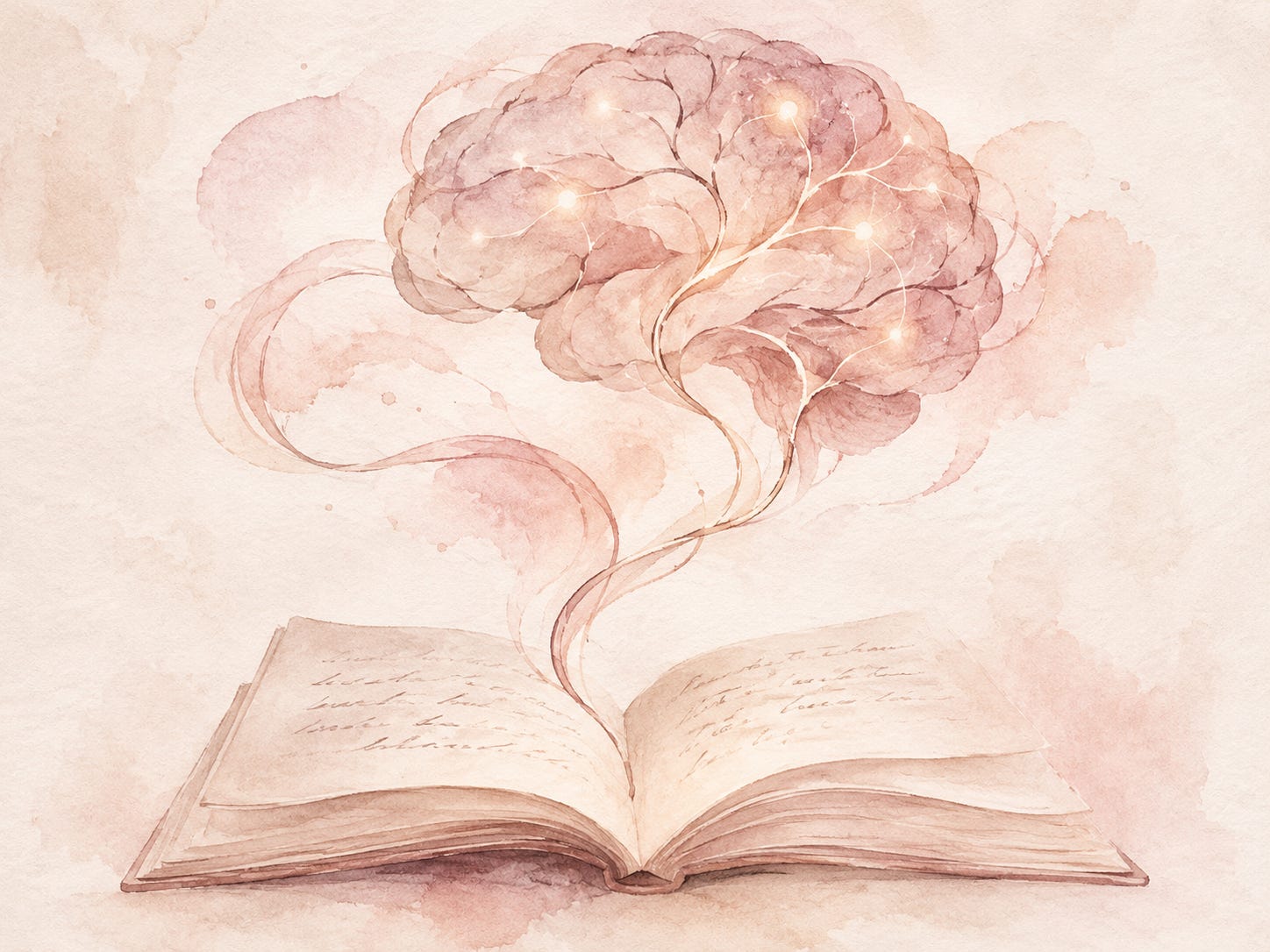
What happens in the brain when we put feelings into words?
Neuroscience offers another fascinating perspective on why reflective writing may support our emotional wellbeing.
In 2007, neuroscientist Matthew Lieberman and his colleagues at UCLA studied what happens in the brain when we put emotions into words.
They discovered that naming emotions was associated with reduced activity in the amygdala, a brain region involved in emotional responses, and increased activity in an area of the prefrontal cortex involved in regulating those responses.
In other words, putting a feeling into words may help the brain respond to it differently.
Think about the difference between carrying an uncomfortable feeling around all day and sitting down to write, “I think what I’m really feeling is disappointment.”
The circumstances haven’t changed. The feeling may still be there. But something has shifted in how we recognise and relate to it.
Although the research examined emotion labelling rather than journaling directly, it offers a fascinating clue as to why reflective writing can be valuable.
Perhaps the power of journaling isn’t simply in getting our thoughts out of our heads.
Perhaps it also lies in how we learn to recognise, understand, and respond to what is happening within us.
What makes journaling different?
Perhaps the most beautiful distinction is that journaling doesn’t ask us to produce something valuable for the outside world.
Its value lies in what happens within us as we write.
We may discover a feeling we hadn’t recognised, a belief we hadn’t questioned, or a longing we had been too busy to notice.
Sometimes writing helps us make sense of difficult experiences. Sometimes it offers perspective. And sometimes it simply gives us permission to acknowledge what is there.
But this raises an interesting question.
If writing can support our well-being, does that mean that every time we fill a page, we are necessarily helping ourselves?
Not quite.
Because what we bring to the page, and what we do with it, may matter just as much as the act of writing itself.
And that is where the next part of our exploration begins.


Leave a Reply